A French drain is a gravel-and-pipe trench that catches subsurface water and carries it somewhere it can legally leave — the street, a swale, a daylight outlet. In Osceola County it’s the standard answer for the soggy strip that never dries: along the fence line, under the downspout run, across the Shingle Creek basin lots in Kissimmee that hold water days after a storm. What you see on the surface is only half the problem; the saturated sand below is what’s drowning the sod roots.
The same crew that digs the trench lays the sod afterward, so there’s no open ditch sitting through the weekend and no second contractor to coordinate. Call (407) 674-2841.
When a French drain is the right fix
Walk the yard the morning after a hard rain and read what’s left:
- A soggy ribbon that outlasts the yard — squishy along the fence, the walkway, or the foundation while the rest of the lawn firms up. That’s subsurface water, and it’s exactly what this drain is for.
- A downspout that’s dug its own creek — roof water carving a mud channel and drowning the turf beside it. A drain that starts at the downspout and carries the water off beats a splash block every time.
- A flat lot with no fall to work with — common near Lake Toho and through the Shingle Creek basin, where regrading can’t manufacture slope that isn’t there. The drain gives the water a pipe instead of an evaporation plan.
- The same dead strip, second lawn — if two rounds of sod have died in the same band, the grass was never the problem. Fix the water, then roll sod replacement over a base that can stay drained.
When the issue is a broad shallow bowl rather than a band, the fix is usually regrade or a swale first.
How sizing works
An undersized drain is a buried disappointment. Four numbers decide whether it works:
- Length — the full wet band plus margin past both ends. Residential runs here usually land between 30 and 100 linear feet.
- Depth and width — 12–18 inches deep, about 12 wide for lawn bands; deeper when the outlet needs fall across a long, flat run. Critically, the trench has to get below the compacted traffic pan, or it only drains the top sand.
- Pipe — 3- or 4-inch perforated pipe, holes down, bedded in washed stone so sugar sand can’t migrate in and choke it.
- Fall — roughly a 1% slope (about an inch of drop per 8 feet) toward the outlet. On Osceola’s flat lots that grade gets surveyed with a level, not eyeballed — a bellied pipe holds water permanently, and standing water inside a drain means it was decorative.
Every run gets wrapped in non-woven filter fabric around the gravel envelope, and the outlet gets a pop-up emitter or a daylight end with a critter guard. The drainage risk checker is a quick way to confirm the diagnosis before anyone digs — and the bucket test in lawn drainage test before sod settles it: a hole that still holds water hours later is a drainage job, not a lawn job.
Install process
- Locate and mark. Utilities flagged, sprinkler lines mapped, and the outlet route walked end to end — the legal exit gets confirmed before the first shovel, not after. Irrigation crossing the trench gets capped and rebuilt afterward, coordinated with irrigation repair.
- Trench and set. Sod strips lifted and stacked in the shade, trench cut to surveyed grade, fabric laid, washed stone bedded, pipe set holes-down with the fall verified.
- Wrap and backfill. Gravel envelope closed and the fabric wrapped burrito-style, then topped with sand as a sod bed — never a clay cap that would seal the drain shut.
- Outlet and test. Pop-up or daylight outlet set at a lower elevation than the whole run, then the trench flooded with a hose to prove water flows end to end before anything gets buried for good.
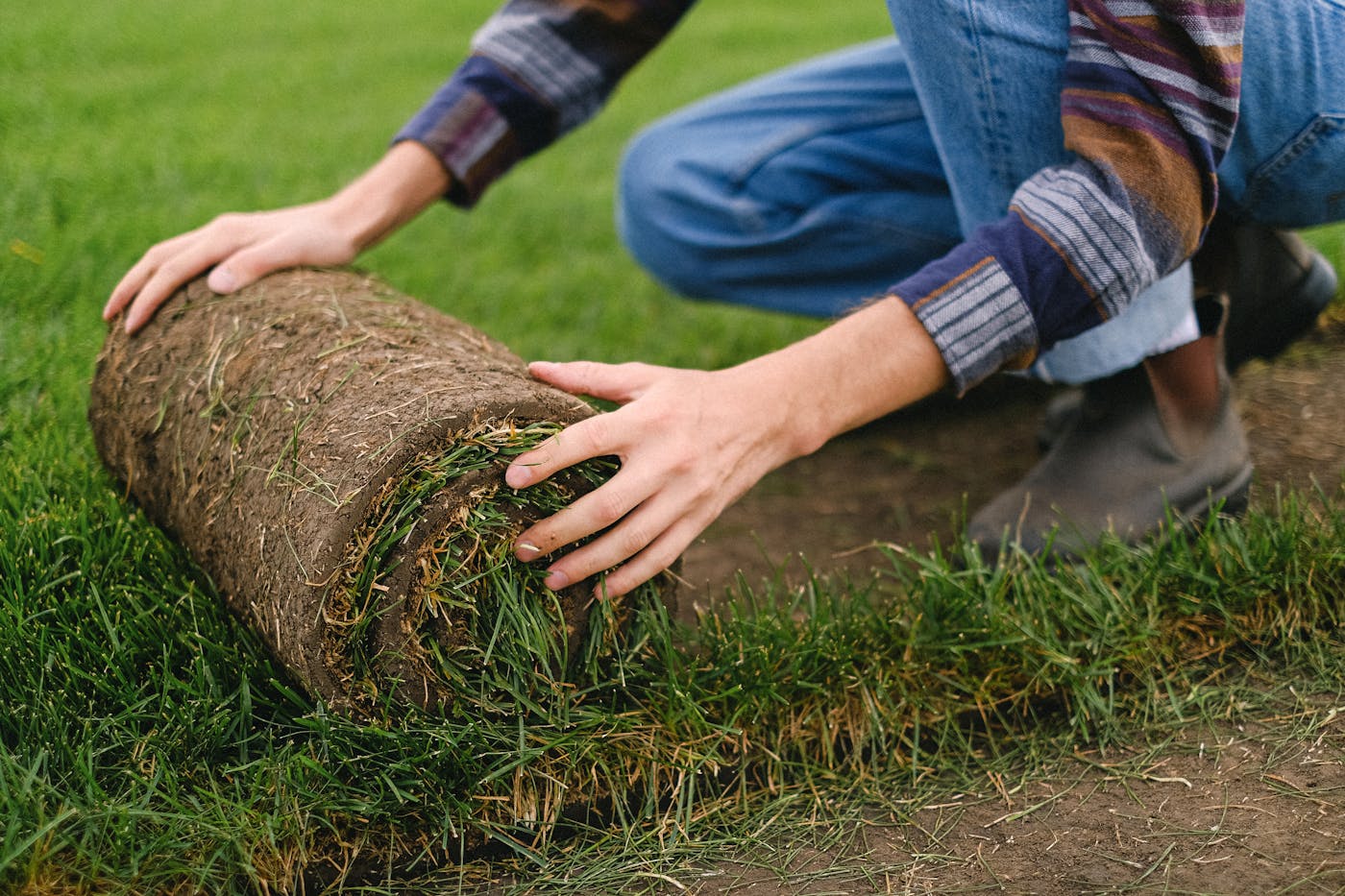
- Restore. Fresh sod rolled over the trench line the same visit wherever possible, so the yard doesn’t wear a dirt scar for weeks.
Dead turf around the work zone gets cut out and hauled the same way as a sod removal job: cut, haul, reset.
Cost bands
Residential French drains in Osceola County typically run $35–$65 per linear foot installed, so a 50-foot lawn run lands around $1,750–$3,250. What moves a quote inside that band:
- Length and depth — longer and deeper means more digging, more washed stone, more haul-off.
- Hardscape crossings — cutting through pavers, concrete, or a driveway apron costs real money compared to open lawn.
- Outlet distance — a short run to daylight is cheap; a 100-foot carry to the street is practically a second project.
- Sod restoration — re-laying the trench line with fresh-cut sod is its own line on the quote.
The written quote breaks out trench footage, pipe and stone spec, outlet type, any hardscape work, and sod restoration as separate lines — if a bid comes in hundreds under the band, it usually skipped the unglamorous line items: haul-off, proper grade, head re-aiming. Compare the install-side numbers with the Kissimmee sod cost guide.
Sod after drainage: the sequence that matters
A drain without new grass is a gravel scar, and new grass over an unsolved wet band is a donation to the next storm. Plan it as one job: water mapped to a legal outfall first, then fresh sod on ground that finally drains. Most drain-plus-sod combos finish in about a week — the sod side installs as a normal job with a 30-day watering plan, not a special case. Start the lawn side at sod installation or match the variety to the lot with the grass selector tool.
Maintenance that keeps it flowing
A good drain is nearly maintenance-free, but “nearly” is doing work in that sentence. Twice a year — April, before the rains, and November, after — walk the run and check three things. First the outlet: pop-up emitters clog with mulch and live-oak leaves, and a blocked outlet turns the whole run into a buried bathtub. Flip it open, clear the debris, run a hose upstream and confirm water exits. Second, the surface trace: if the trench line has settled into a shallow rut, top it with washed sand — never soil, which migrates straight into the stone — so sheet flow still reaches the gravel. Third, the downspout tie-ins: extenders wander and joints separate, and one loose coupling can dump a roof’s worth of water beside the trench instead of into it.
What never happens: heavy equipment across the run, or deep-rooted trees planted on top of it. Oak and palm roots find perforated pipe the way they find sewer lines — keep new plantings at least 6 feet off the trench centerline. Irrigation heads near the run should throw across it, not along it; a head parked directly over the gravel envelope just pours water into the drain. The crew sets the arcs before leaving, and any later controller changes need to respect that layout.
What can go wrong, and how the crew prevents it
Most dead drains share one of four causes, and all four are avoidable. Silt intrusion — pipe laid naked or wrapped in cheap landscape fabric instead of true non-woven geotextile. Every job here specs the fabric-wrapped gravel envelope, verified on site before backfill. Negative grade — a trench eyeballed instead of shot with a level. The crew strings the line and proves it with the hose flood test, because a bellied pipe is permanent. Wrong outlet — the run ending in a “dry well” dug into the same saturated sand that caused the problem. Outlets here go to daylight, to a pop-up at a lower elevation, or to the street where allowed — water needs somewhere to go. Crushed pipe — thin-wall tubing under a driveway or parking pad. Crossings get schedule-40 PVC or a concrete lintel, listed on the quote where you can see it.
If your lot already has a failed drain, say so on the call. Failed runs usually need full replacement, not jetting — sandy fines bonded with oak tannin don’t flush clean — but the replacement can often reuse the old trench line, which keeps the price down.
Real drainage answers, from Osceola lots
Ask for the outfall plan before you ask for the price. Any honest drainage quote for a flat Osceola lot should name — in plain words — where every gallon goes: down the pipe, out the emitter, into the street or the swale, and which easement or curb cut makes that legal. If a contractor can’t walk you to the exit point, the drain has no exit point. We only publish job photos when homeowner permission is on file, and none are published right now. Call (407) 674-2841 and ask where your water goes today, and where it should go instead.
When to call
Call (407) 674-2841 when a soggy band survives more than a day after rain, downspouts are carving holes, or the same strip has killed sod twice. Say your city, the wet band’s length, and where you think the water should exit. Or start at get a sod quote.
Useful local pages
- Yard drainage services
- Drainage solutions
- Sod installation services
- French drain vs swale
- French drains and drainage in Kissimmee — the city page for the Shingle Creek basin lots this service is built around
- French drains and drainage in Orlando
- French drains and drainage in St. Cloud
- French drains and drainage in Poinciana
- French drains and drainage in Celebration
- French drains and drainage in Four Corners
- French drains and drainage in Remington
FAQ: French drains in Osceola County
How long does a French drain last?
Decades when it is wrapped in fabric, bedded in washed gravel, and given a real outlet. Unwrapped pipe silted shut in sandy soil is the common failure — which is why the fabric envelope is non-negotiable.
Will a French drain fix a lake of a backyard?
Only if the water has an exit. Broad flat flooding with no outlet needs a system answer — grading plus swales and basins — mapped on yard drainage.
Can you install in rainy season?
Yes — May through October is when the problem shows itself. Trenches get pumped and worked between storms, and sod restoration roots fast in the rain.
Do I need a permit?
Most lawn-band drains do not, but work near easements, wetlands, or HOA common ground can. Jobs touching county rules are checked against the Osceola County Land Development Code before digging, as described on drainage solutions.