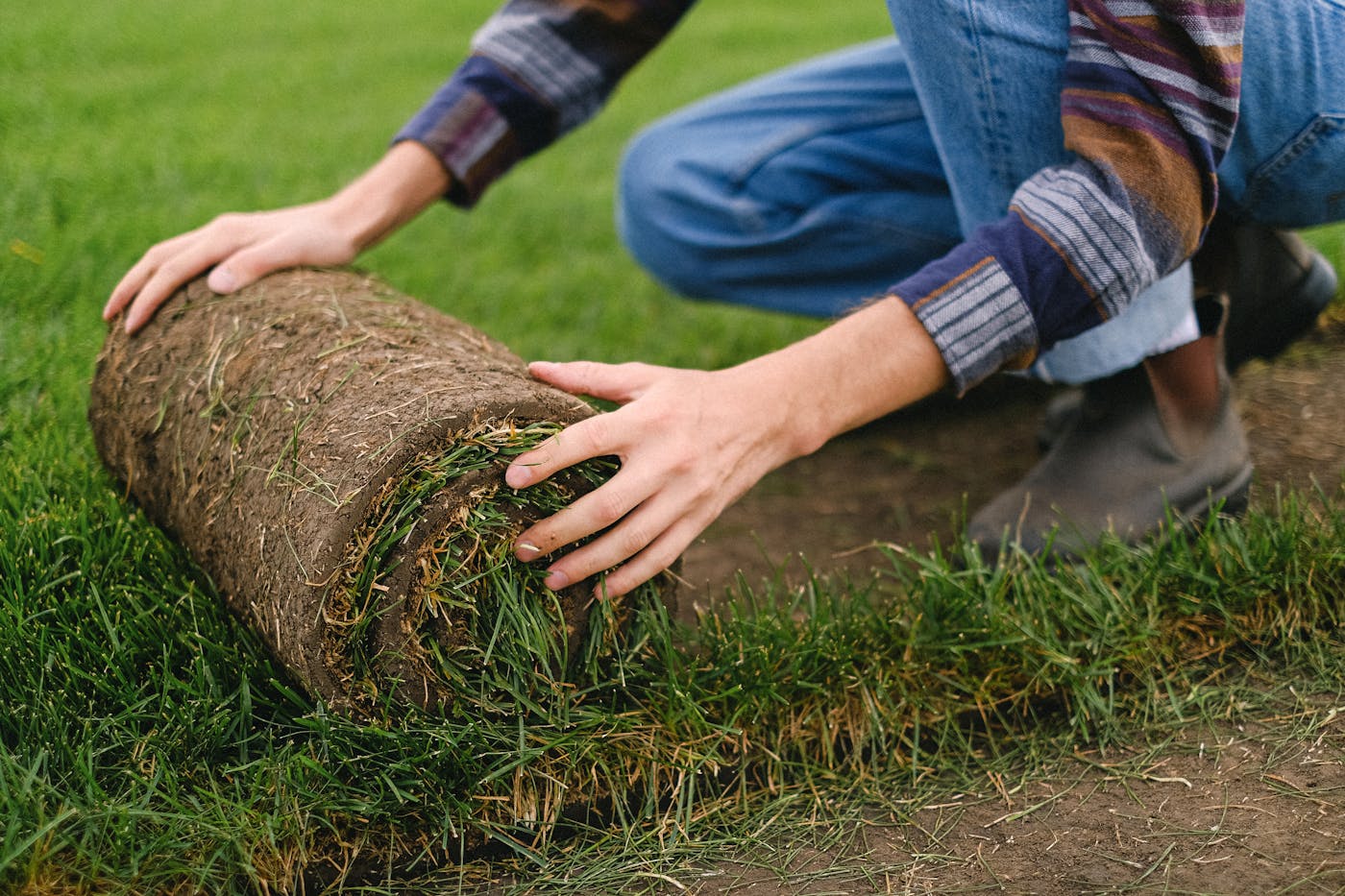
The fastest way to get a bad sod quote is to guess the yard size. Sod is sold by square footage, and most pallets cover a set amount of area. If the measurement is off, the project gets awkward fast: too little sod delays the job, and too much sod sits in the heat.
For most Florida homeowners, the simple formula is:
lawn length x lawn width x waste factor = sod order amount
Then divide by the square feet per pallet your supplier uses.
Short answer: length × width, add 10–12% waste for a normal yard, divide by ~450 sq ft per pallet, round up. A 2,000 sq ft yard orders about 5 pallets.
Quick answer
In Kissimmee and St. Cloud: measure lawn-only rectangles, add 10–12% waste, divide by ~450 sq ft per pallet, round up. A 2,000 sq ft yard orders about 5 pallets. Confirm coverage with the sod calculator, then call (407) 674-2841.
Step 1: Measure the Usable Lawn Area
Start with the biggest rectangle. Measure the longest length and widest width of the lawn area. If the space is not a perfect rectangle, split it into smaller rectangles and add them together.
Example:
- Front yard: 45 ft x 32 ft = 1,440 sq ft
- Side yard: 28 ft x 12 ft = 336 sq ft
- Back strip: 40 ft x 10 ft = 400 sq ft
- Total measured area: 2,176 sq ft
Do not include patios, driveways, pools, landscape beds, sheds, or walkways.
Step 2: Add a Waste Factor
Sod has to be cut around curves, irrigation heads, valve boxes, beds, fences, and sidewalks. A perfectly rectangular lawn may only need 5-8% extra. A curved yard with a lot of beds may need 12-15%.
Use this rule:
- Simple rectangle: add 8%
- Normal suburban yard: add 10-12%
- Curved or complex layout: add 15%
If the measured area is 2,176 sq ft and you add 10%, the order amount is about 2,394 sq ft.
Step 3: Convert Square Feet to Pallets
Many sod pallets are estimated around 400-500 sq ft depending on the farm, variety, and stacking method. A common planning number is 450 sq ft per pallet.
Using 450 sq ft per pallet:
- 2,394 sq ft divided by 450 = 5.32 pallets
- Round up to 6 pallets
You do not want the installer trying to stretch five pallets across a six-pallet yard.
Step 4: Check Irrigation Before Ordering
Pallet count is only half the decision. New sod needs consistent watering immediately. If the sprinkler system has weak zones, broken heads, or poor coverage, fix that before the installation date.
Useful next steps:
- Run the sod calculator
- Build a new sod watering schedule
- Review sod installation service details
Common Ordering Mistakes
The biggest mistakes are easy to avoid:
- Measuring the whole property instead of the lawn area
- Forgetting to subtract beds and hardscapes
- Ordering without a waste factor
- Using the wrong pallet coverage number
- Letting sod sit too long before installation
- Installing before irrigation is ready
Poinciana Large-Lot Math
Big lots surprise owners twice: the turf area is smaller than the parcel but the waste is bigger than expected. Subtract house, driveway, pool, beds, and tree masses first — a parcel that feels like an acre is often 4,000–7,000 sq ft of actual turf. Then walk the curves: each bed arc and sidewalk radius adds cutting waste. On Juniper-style curved streets, 12–15% is honest, not padded.
Stage pallets in shade near the lay zone, not stacked high on the driveway. Lay within hours, longest runs first, cut-ins last. If the count lands exactly on a pallet boundary, round up — the extra half pallet becomes the repair stock for dog spots and settled seams in month two.
Bottom Line
Measure carefully, add realistic waste, and round up to the next pallet. If you are near the cutoff between pallet counts, it is usually better to have a little extra sod than to stop the installation short.
Ordering sod in Osceola County?
What our crew sees: homeowners under-order by skipping the waste factor, then the second delivery sits in afternoon heat. Send us your measurements and we confirm the pallet count free with any quote — sod delivery coordinated so pallets go straight from truck to soil. Turn-key sod installation runs $1.50–$3.00 per sq ft, most jobs in 3–7 days. Call (407) 674-2841 or see sod installation in Kissimmee.
When to call
Call (407) 674-2841 when measurements are rough, the yard is curved, beds eat the rectangles, or two suppliers quote different pallet counts. Send length-by-width numbers and we confirm free. Or start at get a sod quote.
Useful local pages
- Sod installation in Kissimmee
- Sod installation in St. Cloud
- Cheapest sod in Orlando for a large lot
- New sod watering schedule first 30 days
- Sod installation
Measure precisely with the lawn footage estimator before converting to pallets.