Quick answer
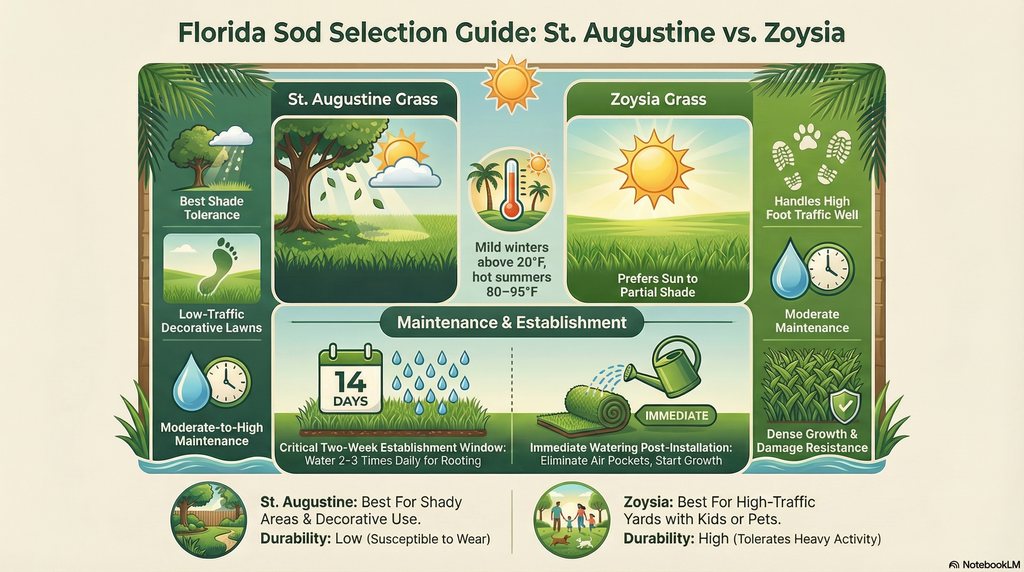
If you want a fast recommendation, start with the Florida grass selector. The short version: St. Augustine (Floratam, Palmetto) is the safe Central Florida default — faster establishment, bolder look, mid-band price. Zoysia (Empire, Zeon) is the premium upgrade — denser, finer-bladed, better traffic tolerance, slower to root, premium price. Homeowners weighing that premium upgrade can review local prep, varieties, and pricing for Zoysia sod in Kissimmee before ordering. Either one dies without working irrigation, so fix water first. For the broader tradeoff see St. Augustine vs Bahia.
Looks: bold vs. refined
St. Augustine has wide blades and an open, lush texture that reads “Florida lawn” from the street. Floratam is the coarsest and most traditional; Palmetto is slightly finer with better shade behavior. Zoysia is a different aesthetic entirely — tight, dense, almost carpet-like, with Empire showing medium texture and Zeon running fine and soft underfoot. On photographed fronts in Celebration or Windermere, Zoysia’s uniformity is its selling point; from ten feet it looks manicured in a way St. Augustine only achieves with perfect mowing.
Neither look survives a mower set wrong. St. Augustine scalped below 3.5 inches thins and weeds invade; Zoysia cut too tall gets puffy and thatchy. The grass does not maintain itself — the look you buy is the maintenance schedule you accept.
Cost installed
Turn-key sod in Osceola County runs $1.50–$3.00 per sq ft (Kissimmee guide). Within that band, Bahia anchors the bottom, St. Augustine sits in the middle, and Zoysia prices at the premium end — the sod itself costs more per pallet and the install is fussier about soil contact. On a 1,000 sq ft front, expect Zoysia to run several hundred dollars over St. Augustine all-in. Quotes that erase the gap are skipping prep or haul-off — ask for the breakout.
Establishment speed
This is St. Augustine’s biggest practical advantage. Floratam roots aggressively and covers mistakes; a well-watered install knits in two to three weeks in warm weather. Zoysia is deliberate — four to six weeks to root solidly, longer in shoulder season, and it punishes skipped watering days harder during that window. If the install must survive a closing date, an HOA photo deadline, or a vacation in week two, St. Augustine is the lower-risk pick. Zoysia rewards owners who will be home to water it in.
Shade, water, traffic
- Shade: Palmetto St. Augustine wins under oaks. Zeon Zoysia handles light shade; Empire wants sun. Deep shade belongs to neither — use beds.
- Water: Both need establishment irrigation and both die on broken zones. Mature Zoysia tolerates short dry spells slightly better; St. Augustine shows stress faster but recovers faster. Neither survives a skipped clock — see new-sod watering.
- Traffic: Zoysia takes kids, dogs, and paths better and repairs itself with runners. St. Augustine handles moderate use; constant foot traffic wears thin spots that weeds colonize.
- Pests and disease: St. Augustine draws chinch bugs in summer heat; Zoysia draws thatch and occasional fungus in overwatered shade. Different scouting, similar vigilance.
The street-match rule
In HOA neighborhoods the comparison is advisory and the street is decisive. A Zoysia lawn on a uniform St. Augustine street reads as nonconforming from the curb no matter how premium the turf — and several HOA approval boards say so in writing. Walk the block: if the row already mixes Zoysia and St. Augustine house by house (common in Windermere, parts of Winter Garden and Celebration), you have a choice. If the street is wall-to-wall Floratam, match it. Confirm the approved list before ordering a single pallet.
Year one: what each grass asks of you
St. Augustine forgives a distracted owner. Water it through the first month, keep the mower high, and it closes ranks fast enough to crowd out most weeds by itself. Its first-year risks are chinch bugs in summer heat and gray leaf spot after long wet spells — both are spottable early if you walk the yard weekly.
Zoysia demands a calendar keeper. The slow knit means seams stay visible for weeks, and every skipped watering in that window sets it back disproportionately. Weeds exploit open Zoysia seams faster than St. Augustine gaps, so pre-emergent timing and hand-pulling matter more in months one through three. The payoff starts around month four: a dense mat that needs less water per week than St. Augustine and shrugs off foot traffic that would thin Floratam. Properties that need that dense, traffic-tolerant mat can compare install details for Zoysia sod in St. Cloud once irrigation is confirmed. If you travel often or delegate the yard to whoever remembers, buy the forgiving grass. If you will actually follow the schedule, Zoysia rewards it.
Common mistakes
- Buying Zoysia for deep shade. Premium price, predictable failure. Shade matching beats grass prestige every time.
- Under-budgeting establishment care. Zoysia’s slow rooting plus a skipped week equals seams that never knit. Plan to be present or to delegate watering.
- Mowing both the same way. St. Augustine high (3.5–4.5 in), Zoysia lower (1.5–2.5 in depending on variety). One mower height does not serve both.
- Ordering before the irrigation test. The comparison is moot on a starved zone. Run every head first — blocked heads and dry spots kill premium sod exactly as fast as budget sod.
When to call
Call (407) 674-2841 when you have picked a direction and want a side-by-side quote, when the street standard is unclear, or when shade plus HOA rules make the choice genuinely ambiguous. Say your neighborhood and sun conditions — the recommendation changes with both. Or start at get a sod quote.
Bottom line
St. Augustine is the fast, forgiving default; Zoysia is the dense, premium upgrade that demands patience and precise mowing. Match the street, price the establishment honestly, prove the irrigation — then buy the look you will actually maintain.