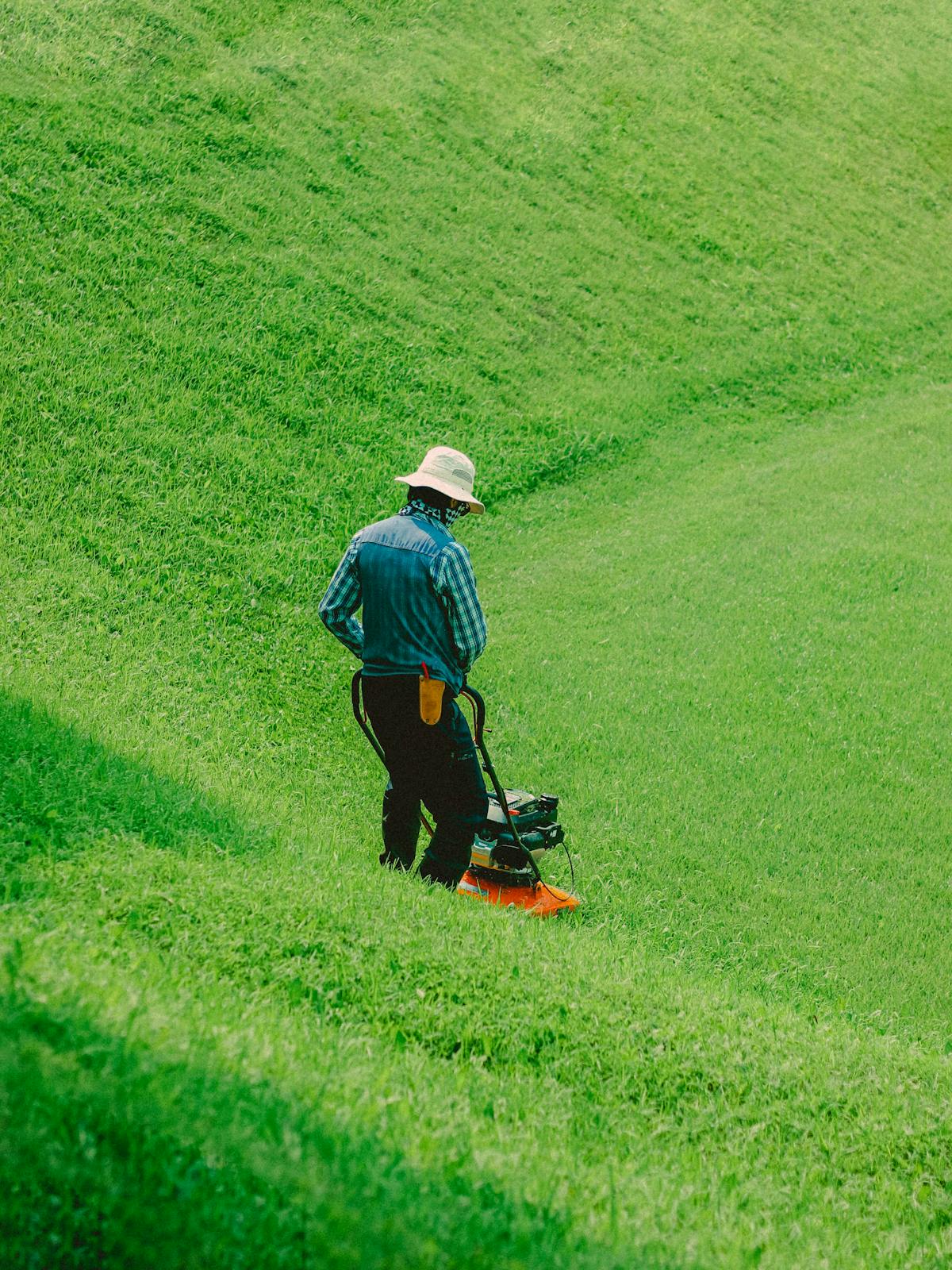
In Campbell, grading is where a rural-residential lot either learns to shed a storm or keeps sending it toward the house. This small unincorporated pocket between Kissimmee and St. Cloud carries its farm past in its soil, and lots in 34743 that were worked as agricultural ground long before they were lawns rarely sit flat, firm, or honest once fill settles around a slab.
That history is why a first sod installation here deserves a grade check before a pallet count. A corner that looks merely low on a dry morning can be the bowl that ponds at the slab after rain, a ranch well pad can hide a hard pan under loose sand, and a high edge the mower scalps can sit only feet from the dip that never dries.
When Campbell Homeowners Need Lawn Grading
Campbell calls tend to start at one corner: water gathered against the slab, a low pocket that stays soft while ground a short drive away in downtown St. Cloud sheds cleanly, or turf that rooted everywhere except the same settled hollow. The page’s own test applies here — this is Campbell in the St. Cloud grain of 34769, not downtown, and the slab corner is the grade that decides the job.
On a Campbell property, hold the sod order until settled soil, runoff paths cutting across open ground, and any uneven base left by the lot’s agricultural past have been read together. Leave a leftover bowl in place and it can drown new turf in its first week, turning a grading problem into a second sod bill.
Common signs include:
- Brown seams or dry edges after watering
- Water standing after a normal afternoon storm
- Soft soil, sinking spots, or uneven mower lines
- Sprinkler zones that miss corners or overspray concrete
- New sod that looks good for a week and then declines
Local Conditions in Campbell
Campbell’s open, rural-residential lots expose grade problems differently from a tight subdivision lot. There is often more ground for water to cross, more old agricultural surface under the newer residential use, and fewer hard edges to hide a bad pitch — so a runoff path, once established, tends to keep following itself across 34743 sand until someone re-cuts it.
Sand alone is not the excuse here, because Campbell sand drains fast when the shape lets it. Trouble builds where fill has settled unevenly, where a pad or well area was compacted and never broken up, or where a low corner collects what the rest of the lot sheds. From May through October those pockets stay wet while sun-baked high ground only feet away dries hard along concrete.
Zip codes commonly associated with Campbell include 34743. If your property is close to a lake, new subdivision, conservation edge, or older neighborhood street, the site may have its own drainage or sprinkler pattern that needs to be seen in person.
What We Check Before Recommending Work
On a Campbell lot we start at the slab corner and the lowest pocket, then work outward: is water ponding where the house meets the grade, is a ranch well pad shedding or holding, and does a string line show a dip deep enough that fill — not topdressing — is the honest fix?
We look at:
- Lawn square footage and service access
- Slope toward patios, sidewalks, driveways, or neighboring lots
- Soil texture, compaction, and low areas
- Existing sprinkler head height, spacing, and pressure
- Downspout discharge and stormwater flow
- Grass type, sun exposure, and traffic patterns
This keeps the job from becoming a guess. It also helps decide whether the next step is repair, prep, replacement, or a full install.
Practical Process for Lawn Grading in Campbell
Campbell grading follows the water, not a preset machine pass. On an open lot the sequence runs:
- Photograph where stormwater sits at one hour and at four, so a true birdbath is not confused with whole-yard flooding.
- String the suspect low corner and probe it — a screwdriver stopped by pad-fill pan is finding the same barrier roots will hit.
- Cut the high edges the mower scalps and fill the dips deeper than two inches rather than dressing over them.
- Re-pitch the slab corner so the lot sheds away from the house instead of ponding against it.
- Soak or wait out a storm, touch up any spot the water exposes, and only then bring in sod.
Sequence protects the finish here: grade proved before grass is why a Campbell regrade can move quickly on open ground, while fenced work with haul-off honestly takes longer.
Mistakes to Avoid
Campbell’s costliest shortcut is sodding the low corner because the rest of the lot looks ready. That one bowl is where the first storm collects, and it is where the new pallet fails while the higher ground roots fine.
Shortcuts that show up again on 34743 lots:
- Laying turf straight onto an unbroken ranch well pad without regrading the pad to shed first.
- Filling a dip without deciding where its water goes next, so the pond simply moves toward the slab.
- Grading and sodding the same day, skipping the soak that would have revealed the settled spot.
- Raising the surface and leaving sprinkler heads sitting too low in the new grade.
If you are not sure what is driving the issue, use the drainage risk checker before requesting a quote. It gives you a better way to describe the problem on the call.
How This Connects to Sod and Irrigation
In Campbell the three trades meet at that slab corner: grading decides whether runoff leaves the lot or ponds at the house, drainage handles what the pitch cannot move on its own, and irrigation has to be reset to the new surface before first-time sod goes down on ground that used to be agricultural. A well pad that finally sheds, for instance, changes both where water travels and how the zones over it should run.
That is why this page links into the broader service path:
- Review the main Lawn Grading service page.
- Use the drainage risk checker to narrow the issue.
- Compare related help with sod calculator.
The goal is simple: fix the cause first, then make the lawn look finished.
Quote Notes for Campbell
For a Campbell quote, lead with 34743, whether the lot is open or fenced, and where the water ponds — especially if it gathers at the slab or sits over a well pad — plus any storm photos showing the low corner at its worst.
For Campbell homeowners, the most useful details are:
- How long water stands after rain
- Which sprinkler zone looks weak or wet
- Whether the problem is near concrete, a fence, or a low side yard
- Whether the lawn is new sod, old turf, or a new-build handoff
- Any HOA, gate, pet, or access constraints
Campbell: Does Campbell grain 34769 pond at the slab while downtown St. Cloud sheds
Does Campbell grain 34769 pond at the slab while downtown St. Cloud sheds?
Yes. Campbell is St. Cloud grain 34769, not downtown St. Cloud. The slab corner is the grade. (407) 674-2841.
Do we regrade the ranch well pad before sod?
Regrade first on a ranch well pad. Sod after the pad sheds. (407) 674-2841.
Will new sod fail if we skip the Campbell low corner?
Yes. A leftover bowl in 34769 drowns a pallet the first week. (407) 674-2841.
Level bumps before sod
Scalps every cut or dips that hold water: lawn leveling and topdressing. Slope and water direction first: lawn grading.
Quick answer
Yard leveling in Campbell (34743) starts with water movement, not a pallet count: where stormwater sits, where fill settled, where the mower scalps the high spots. We cut, fill, pitch, and verify before sod pairs at $1.50–$3.00/sq ft. Same-week grade on open lots, longer on fenced regrades with haul-off. Call (407) 674-2841.
Grading fit check for Campbell
Grading earns its keep where the ground is the problem: standing water after a normal Campbell storm (34743), birdbaths that breed fungus and mosquitoes, sod that rooted everywhere except the same soggy corner twice, a slab or fence line taking runoff. Sandy soil drains fast but settled fill, compacted pad, and hardpan do not — the lawn photographs the low spot long before anyone strings a line level. If every zone runs head-to-head and the grass still drowns in one place, that place needs dirt work, not more minutes on the controller.
Three quick tests before you call: (1) after the next storm, photograph where water sits at one hour and at four — birdbaths versus whole-yard flooding are different jobs; (2) run a string line across the suspect area — dips over two inches want fill, not topdressing wishes; (3) probe the soil with a screwdriver — pad-fill pan that stops the probe stops roots too. That holds across Osceola County sand. Call (407) 674-2841 with the photos and 34743.
Reading a grade-plus-sod quote in Campbell
A real Campbell grading quote lists low spots and pitch lines found, yards of cut and fill, compaction work on pad fill, haul-off or import by load, the settle-verify step, and the sod side measured separately — square footage, variety, install dates in sequence, and the watering schedule at $1.50–$3.00 per sq ft. Ground proven first, sod second, in writing.
Red flags: a sod price with no grade line on a yard that holds water, same-day grade-and-sod with no settle step, per-pallet sod pricing with no install line, and anyone promising rooting without a schedule. Fresh sod on proven ground roots in 10–14 days; the tug test should resist a firm pull. Call (407) 674-2841.
Water behavior after the Campbell grade
Campbell sand drains fast, which a fresh grade must respect: water should sheet evenly off the pitch lines and out to daylight, never sit in the old birdbaths or run at the slab. The first storm after grading is the inspection — walk it, photograph the flow, and touch up any liar before sod. Short verification soaks on your watering days beat a timer program left over from before.
Then the schedule resets to county days once sod is down: deep cycles that push roots through the new grade instead of daily sips that keep them shallow. A regraded yard on a smart controller holds 34743 compliance without babysitting — rain skips, seasonal adjust, per-zone programs. Wells run fine on graded ground; iron staining on fences is cosmetic. Sod goes down only after the settle-verify proves the shape. That holds across Osceola County sand. Call (407) 674-2841.
Campbell grading, documented
A Campbell grade is proven on paper and in the first storm, not by a smooth-looking surface on install day. The record that matters is the measured footage of the area reworked, the pitch and grade plan named on the quote — which way the slab corner sheds, which low pocket gets filled — and the soak or storm settle-verification that followed before sod was ordered. Where sod pairs with the grade, the finish check is timing: fresh turf on proven Campbell ground should root in 10–14 days, with the tug test resisting a firm pull.
We only publish job photos when homeowner permission is on file, and none are published right now. What we can show you today is that written sequence — footage, pitch plan, settle-verify, tug test — applied to your own 34743 lot. Call (407) 674-2841.
When to call from Campbell
Standing water, birdbaths, washouts, or a slab taking runoff — call (407) 674-2841 from this page with 34743 handy. We walk the pitch lines, price dirt apart from any sod, and settle-verify before sod, usually inside two weeks for open lots.
Related: sod installation in Campbell, irrigation repair in Campbell, st augustine sod in Campbell · get a sod quote · grass quiz