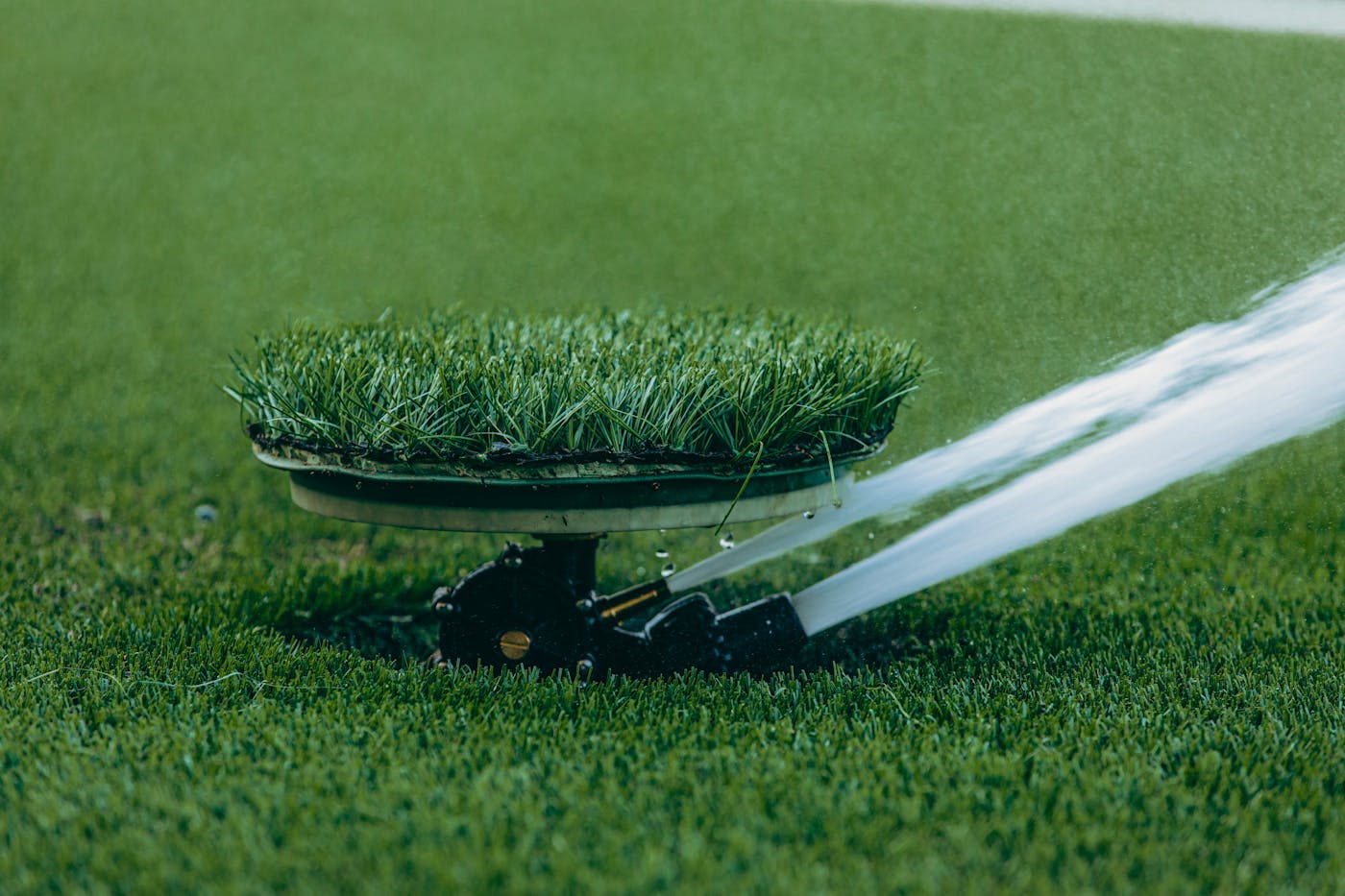
Installing sod before checking irrigation is a common mistake. The lawn may look perfect on day one, then dry corners and brown strips appear because the sprinkler system cannot cover the new turf evenly.
Good sod installation starts with water planning.
Quick answer
In Kissimmee, St. Cloud, and Poinciana, plan zones before sod goes down: 4–8 zones on a typical quarter-acre lot, sprays and rotors on separate runs, head-to-head spacing, and a controller with 2 spare zones. Trenching and height-setting happen on bare soil — fixing zones after sod means cutting new turf. Call (407) 674-2841.
Head-to-Head Spacing Is the Rule
Spray heads are designed so each head throws far enough to reach its neighbor — head-to-head coverage. When installers stretch spacing to save heads, the gaps show up as brown strips about six weeks after sod day, right when the lawn should look its best. On Osceola County’s sandy soil the margin is thinner, because sand drains fast and gives no lateral wicking to forgive a gap.
Walk the test run with flags: every dry triangle between heads is a spacing failure, not a grass failure. Fix it by adding a head or swapping to a higher-arc nozzle, never by doubling run time — doubling run time drowns the covered areas while the gap stays merely damp.
Narrow Strips Get Their Own Zone
Side yards between houses in Kissimmee and Poinciana are the classic failure: a 4-foot strip watered by the same zone as the open front. Full-size rotors overshoot into fences and sidewalks, and the strip either floods or gets skipped. Strip sprays or short-radius nozzles on a dedicated zone solve it, with run times a fraction of the turf zones.
Same logic for beds versus turf. Beds want drip or micro-spray on long slow soaks; turf wants overhead on shorter cycles. One zone serving both guarantees one of them is wrong. Separating beds out is a small manifold cost that pays back in every water bill.
Controller Capacity and Wire
Count the zones, then buy two more than you need. The spare terminals cover the bed split you will want next year and the strip zone the last installer skipped. Run a common wire with spare conductors in the same trench — retrenching for one added wire later costs more than the whole original wire bundle.
Smart controllers earn their keep in Osceola County specifically: seasonal restriction shifts and afternoon storm skips are automatic instead of a reminder you forget in July. A basic timer works, but someone has to reprogram it four times a year, and that someone is usually nobody.
Why Zones Matter
A sprinkler zone is a group of heads that runs together. If too many heads are placed on one zone, pressure drops. If the wrong heads are mixed together, some areas get too much water while others stay dry.
Bad zone design can cause:
- Brown strips between heads
- Overspray on sidewalks
- Dry corners
- Puddles near low spots
- Weak spray at the end of a zone
- Long run times that still do not water evenly
Do Not Mix Head Types Carelessly
Spray heads and rotors often apply water at different rates. If they run together on the same zone, one part of the yard may receive far more water than another.
That does not mean mixed systems are impossible. It means they need proper design.
Check Pressure and Flow
Sprinkler planning is not only square footage. A professional design looks at pressure, gallons per minute, pipe size, valves, head type, and spacing.
As a homeowner, you can still do a useful first check:
- Run one zone at a time
- Watch for weak heads
- Mark dry corners
- Look for leaks around heads
- Confirm rotors turn fully
- Check whether the controller has enough zones available
Use Zones to Protect New Sod
New sod needs consistent moisture. If one area dries faster, it may fail even if the rest of the lawn roots well.
Before installation, ask:
- Are all heads raised to the correct height?
- Will sod block any heads?
- Are beds and turf separated?
- Do narrow strips have their own coverage?
- Are low areas draining correctly?
Try the sprinkler zone planner to get a rough starting point, then review irrigation installation for professional layout help.
When to call
Call (407) 674-2841 when dry corners appear, one zone runs weak, heads sit below grade after sod, or the controller is full with beds still to split. Say your city and whether the water is city or well. Or start at get a sod quote.
Useful local pages
- Irrigation installation in Kissimmee
- Irrigation repair in Kissimmee
- Irrigation installation cost before sod
- Sprinkler repair cost in Osceola County
Bottom Line
Sod and irrigation should be planned together. A beautiful lawn can fail quickly if the sprinkler zones cannot support it.