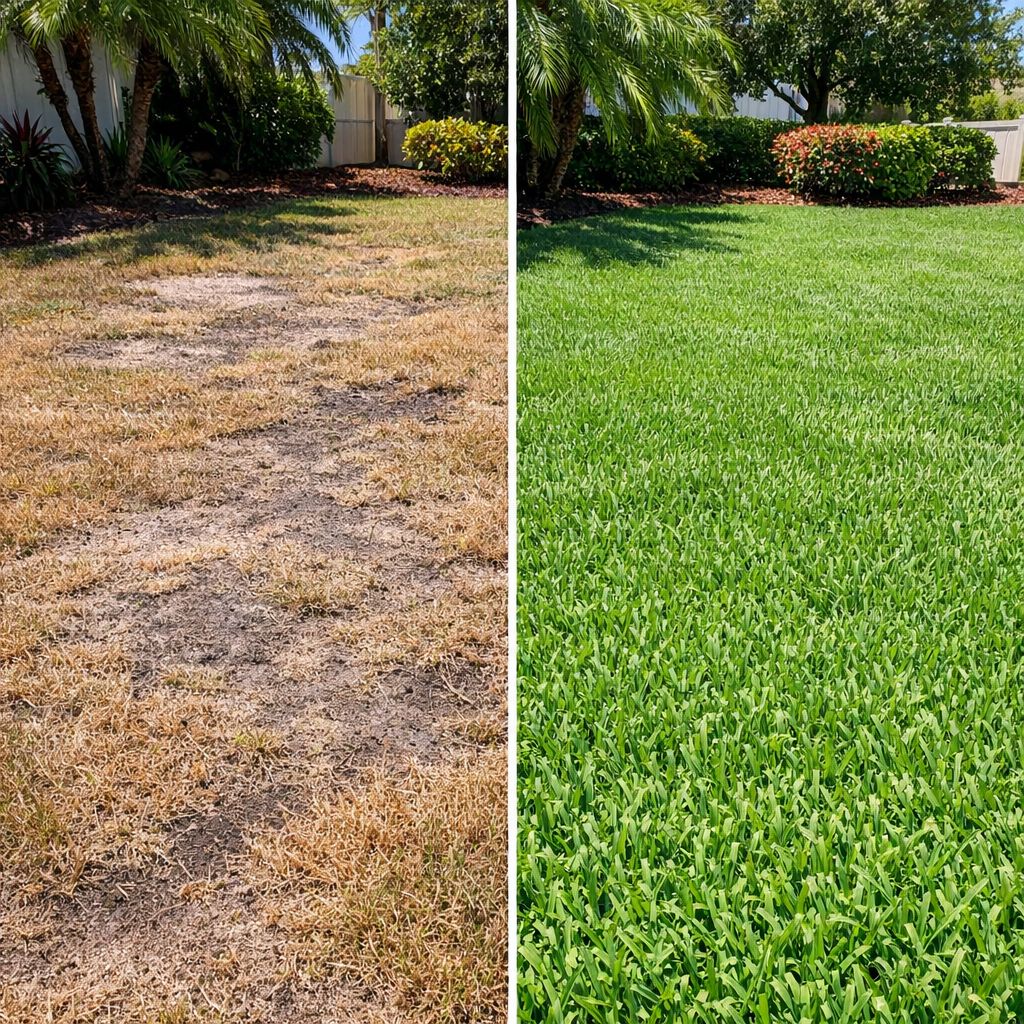
Half of Central Florida’s brown lawns get the wrong first treatment, because fungus and chinch bugs make the same brown patches — and the fix for one feeds the other. Ten minutes with a tin can and a tug test tells them apart before you spend a dollar. Call (407) 674-2841.
The cost of guessing wrong is a month per mistake: fungicide on chinch lets insects eat outward for four more weeks, while insecticide on fungus does nothing as the rings spread — and the extra watering insecticide labels want accelerates the disease. Diagnose, then treat.
Written September 2026 for St. Augustine lawns in the Orlando–Kissimmee corridor. The same tests work on Zoysia; Bahia rarely hosts either problem at treatment level.
Already at bare soil? Skip to the re-sod decision at the bottom — see sod installation or price it with the sod calculator. Still in the yellow-patch stage? Run lawn problem diagnosis alongside this guide. Call (407) 674-2841.
Quick answer
Chinch: patches spread from pavement in hot dry weather, turf stays rooted, tin-can test floats live bugs. Fungus (brown patch / gray leaf spot): rings or leaf lesions after wet humid spells, turf stays rooted, no bugs in the can. Treat only the confirmed problem, spot-only, then fix the water. Bare-soil craters get re-sodded either way.
Test 1: the tug test (30 seconds)
Grab a handful of brown-edge grass and pull firmly. Then push the sole of your shoe sideways across the patch.
- Stays anchored, roots hold: chinch or fungus — both leave roots intact. Proceed to Test 2.
- Lifts like loose carpet with stubby chewed roots or bare soil: neither — that’s grubs. See our grub test guide.
- Mushy, slimy, sour-smelling: overwatering with rot underneath. Stop watering, check drainage with the drainage risk checker, and read our overwatering coverage — then re-test for disease once the soil firms.
The tug test rules grubs and rot in or out. It cannot separate chinch from fungus — that is the tin can’s job.
Test 2: the tin-can test (10 minutes)
Cut both ends off a coffee can, push it 2–3 inches into the turf at the yellowing outer edge of a patch (never the dead center — insects move outward to fresh grass), fill with water, hold 5–10 minutes, and watch for small black-and-white bugs floating up.
- Bugs float (a dozen-plus): chinch confirmed. See our summer chinch-bug watch for the full treatment calendar — spot-treat the patch plus a 5-foot buffer, recheck in 7–10 days.
- Nothing floats after testing 2–3 edges: chinch unlikely. Move to the pattern read below for fungus.
- A couple of strays: inconclusive — treat the pattern, not the strays. Re-test in a week if patches keep spreading.
Do the can test in the morning when insects are high in the canopy, and test multiple patches. One negative can lies; three rarely do.
The pattern read: what fungus looks like
With chinch negative, read the patch geometry and the leaves:
- Brown patch (Rhizoctonia): roughly circular brown areas, sometimes with a darker smoky outer ring, from inches to feet across — classic in warm wet spells on overfed or overwatered St. Augustine. Look for the ring; chinch never makes rings.
- Gray leaf spot: tan oval lesions with dark borders on the blades themselves, worst in summer on new growth and stressed turf. Hold blades to the light — spots on leaves mean disease, not insects.
- Follows water and weather: disease outbreaks trail rainy weeks, broken sprinkler heads stuck on, and nitrogen pushes. If the outbreak maps exactly onto the soggiest zone, that’s a confession.
- Shady and damp: fungus dominates where morning dew lingers — under oaks, along north fences. Chinch dominates hot sunny pavement edges. Location is evidence.
Fungus fix: correct the moisture first (back off frequency, water early morning only, fix stuck heads with the watering schedule tool), then apply a labeled fungicide (azoxystrobin / propiconazole-class per label) to the affected area if the outbreak is active and spreading. Don’t fertilize diseased turf — soft growth is disease food.
The pattern read: what chinch looks like
- Starts at heat edges: driveways, sidewalks, curbs, south-facing slopes — spreading outward in irregular yellowing patches with no ring and no leaf spots.
- Follows heat and drought stress: worst in the hottest dry stretch, in full sun, on underwatered or compacted zones. Well-watered shaded turf beside a devastated sunny strip is practically diagnostic.
- Ignores water: the killer tell — patches that keep spreading for two weeks of correct irrigation. Drought greens up; chinch doesn’t.
- Season: June–September peak, lingering into hot Octobers. February brown is never chinch here.
Chinch fix: spot-treat confirmed patches plus a 5-foot buffer per label, water in, recheck with the can in 7–10 days, and correct the irrigation stress that invited them. Full detail in our summer chinch-bug watch.
When it’s both (September special)
Chinch-thinned turf holds dew in ragged gaps, and stressed grass is disease-prone — so late summer routinely serves both problems in one lawn. Handle them in order:
- Confirm each independently — can test for chinch, ring/lesion read for fungus. Don’t assume the second from the first.
- Treat the insects first — insecticide labels want watering-in, and you want the insect problem closed before adjusting the moisture regime for disease.
- Then correct moisture and treat disease if lesions are still active and spreading.
- Hold fertilizer until both are resolved and runners are spreading — feeding a sick lawn feeds the sickness.
Document with phone photos from the same spot weekly. “Spreading” vs “stable” is the treatment decision, and memory lies about both.
When to stop treating and re-sod
Either problem ends in re-sodding when the biology is gone: patches that pull up with no roots over bare soil, craters unchanged after a month of correct treatment and water, or lawns where combined damage exceeds roughly a third of the visible area (patchwork recovery takes longer than replacement and looks worse for a year). Match the existing variety, fix the water or drainage that enabled the failure, and replant in warm soil. See sod installation — most patch re-sods finish in 3–7 days. Call (407) 674-2841 with photos and square footage.
FAQ: fungus vs chinch in Florida
How do I tell fungus from chinch bugs?
Tug test (rules out grubs), then tin-can test at patch edges (confirms chinch), then pattern read: rings and leaf lesions mean fungus; pavement-edge spread in heat means chinch. Ten minutes, no guessing.
Can a lawn have both at the same time?
Yes, especially in September. Test each on its own evidence, treat insects first, then correct moisture and treat disease. Hold fertilizer until runners spread.
Is it safe to just treat for both?
No — blanket insecticide kills chinch predators, and extra water for insecticide spreads fungus. Two wrong applications cost more than ten diagnostic minutes and often make both problems worse.
When should I re-sod instead of treating?
Bare-soil patches with no roots, or treated zones unchanged after a month of correct care. See sod installation, (407) 674-2841.